





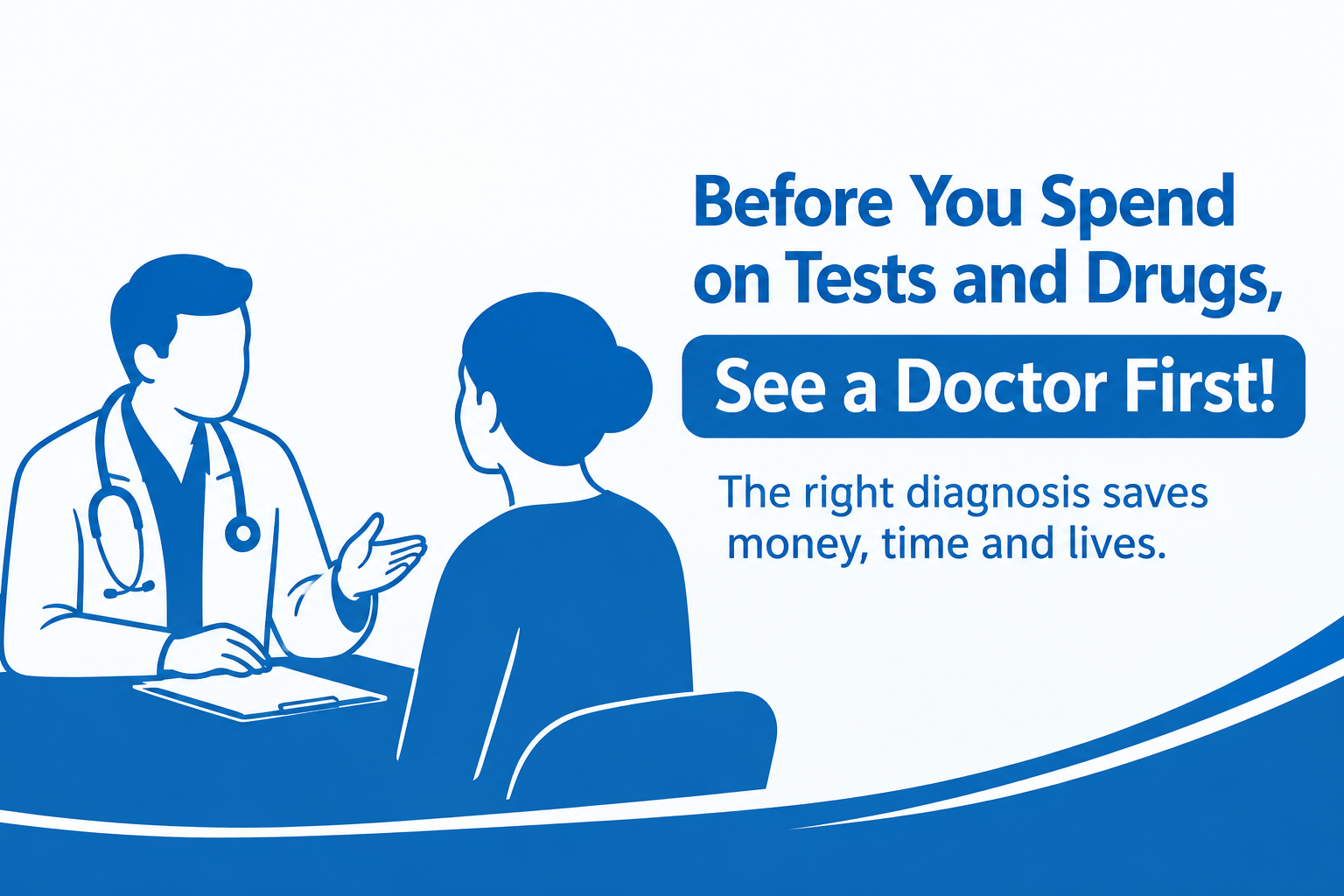
Before You Spend on Tests and Drugs, See a Doctor First!
Always make informed decisions and avoid unnecessary repetition of tests or medicines. If the cost of recommended investigations or treatment is a concern, discuss it openly. Your healthcare team may be able to prioritise the most important investigations, consider suitable alternatives, or plan treatment in The right diagnosis saves money, time and lives.
Many people visit laboratories for tests, interpret the results themselves, and buy medicines from chemists or patent medicine vendors to treat what they believe is their illness. Often, they do this in good faith, hoping to save money and get well quickly. With the rising cost of living and healthcare, it is understandable that families want to reduce expenses wherever possible.
However, what appears cheaper at first may become more expensive in the long run. Different illnesses can produce similar symptoms, and an abnormal laboratory result does not always mean that a person has a particular disease. Sometimes, a test may be unnecessary, the wrong test may be requested, or the result may be misunderstood. Treating the wrong condition can delay proper care, waste money, cause harmful drug reactions, and even worsen the illness.
Here are four important ways to get better value for your healthcare spending.
1. Consult a Qualified Healthcare Professional First
Imagine developing a fever, headache and body weakness. You suspect malaria, so you visit a laboratory, pay for a malaria test, and then purchase antimalarial drugs. A few days later, you are still unwell and spend more money on another test and another set of medicines. What if your illness was not malaria in the first place? What if it was a urinary tract infection, pneumonia, typhoid fever, or another condition requiring a different approach? The money spent on the initial test and treatment might have been avoided or better directed if you had sought professional assessment first. Although these illnesses can have overlapping symptoms, they do not all require the same investigations or treatment.
A consultation is more than simply paying a doctor to prescribe drugs. It is an opportunity for a trained professional to listen to your complaints, ask relevant questions, examine you, consider possible causes, and determine the next appropriate step. Sometimes, the diagnosis can be made from your history and physical examination without any laboratory test. In other situations, investigations are necessary to confirm a suspected diagnosis or exclude a dangerous condition. This process helps direct your money towards what is genuinely needed.
2. Do the Right Tests, Not Just More Tests
Laboratory investigations are valuable tools in modern medicine, but their usefulness depends on selecting the right test for the right reason and interpreting the result correctly. Consider someone who frequently feels tired and assumes that they have low blood levels. They may pay for a full blood count, malaria test, blood sugar test and several other investigations without knowing which are necessary. Even when a test identifies an abnormality, that finding may not explain the person’s symptoms. For example, a laboratory result outside its reference range does not automatically establish a disease, and a result within the normal range does not always exclude one. Some conditions require repeat testing, additional investigations or interpretation alongside the patient’s clinical findings. Ordering more tests does not necessarily mean obtaining better healthcare.
A qualified healthcare professional helps determine which investigations are likely to answer an important clinical question. This approach can reduce unnecessary expenditure, avoid confusion from incidental or misleading findings, and minimise the risks associated with certain investigations. It also helps ensure that abnormal results receive appropriate attention rather than being ignored or treated in isolation. Patients who have already undergone testing should not feel that their money has been wasted or that they must repeat every investigation. Instead, they should take their results to their healthcare professional, who can assess whether the tests are relevant, reliable and recent enough to guide treatment. Some results may be sufficient, while others may need confirmation or further assessment. The goal is not to do as many tests as possible, but to obtain the information needed to make sound healthcare decisions. Wise investigation means spending money on answers that can genuinely improve patient care.
3. Use Medicines Responsibly
Medicines can relieve suffering, cure infections, control chronic illnesses and save lives. However, they can also cause harm when used incorrectly. Buying medicines based on symptoms, a friend’s recommendation, or a laboratory result interpreted without adequate clinical assessment can lead to inappropriate treatment. Antibiotics, for instance, treat certain bacterial infections but do not treat viral illnesses such as the common cold. Unnecessary antibiotic use can cause side effects and contribute to antimicrobial resistance, making some infections more difficult to treat in the future. Similarly, painkillers may relieve pain without addressing its underlying cause, while some can cause stomach bleeding or kidney problems when used inappropriately.
Responsible medicine use begins with identifying the condition as accurately as possible and selecting an appropriate treatment. A qualified prescriber considers factors such as age, body weight where relevant, pregnancy status, allergies, kidney and liver function, other illnesses, and medicines already being used. Patients should follow the prescribed instructions, avoid sharing prescription medicines, and seek advice before stopping, changing or combining treatments. Medicines should be obtained from appropriately licensed and regulated sources, and pharmacists can provide valuable guidance on their safe use.
4. Seek Professional Advice Before Changing Treatment
Sometimes, people begin treatment on their own and only seek medical attention when they fail to improve. Others stop taking prescribed medicines as soon as they feel better, switch to another medicine recommended by a friend, or add herbal preparations and other remedies without informing their healthcare professional. These decisions may appear reasonable, particularly when the cost of treatment is becoming difficult to manage. However, improvement in symptoms does not always mean that the underlying condition has resolved. In other cases, a medicine may be ineffective because the original diagnosis was incorrect, the dose is unsuitable, or the illness requires a different treatment approach. Changing medicines without understanding the reason for treatment failure can make it more difficult to determine what is happening and may expose the patient to avoidable risks.
If you have already paid for laboratory tests or purchased medicines before consulting a doctor, do not be embarrassed or assume that the money has been wasted. Bring your test results, prescriptions, medicine packages and any relevant treatment records to your appointment. Explain what you have taken, the doses, how long you have used them, and whether your symptoms have improved or worsened. This information helps the healthcare profession stages where clinically safe. However, do not delay emergency care while gathering records or trying to arrange a consultation. Honest communication with your healthcare professional helps protect your health and ensures that the money you spend contributes as much as possible to your recovery.
Your Health Is Worth the Right Decision
We understand that healthcare costs are a real concern for many families. Every naira matters, especially when household income must cover food, school fees, transportation and other essential needs. That is precisely why healthcare decisions should be guided by good information rather than guesswork. Unnecessary tests, inappropriate medicines, repeated consultations caused by delayed diagnosis, and complications from incorrect treatment can place a much greater financial burden on families than a timely, appropriate assessment.
The purpose of professional healthcare is not to make patients spend more money. It is to help them understand their health problems, identify the investigations they need, and receive safe and effective treatment. Patients also have an important role to play by asking questions, sharing accurate information, following appropriate treatment advice and discussing financial limitations openly with their healthcare team.
Before you investigate, medicate, or spend more money, consult a qualified healthcare professional.
At WholeCare Hospital, we believe that good healthcare begins with the right assessment, appropriate investigations, and responsible treatment.











Post Comment