


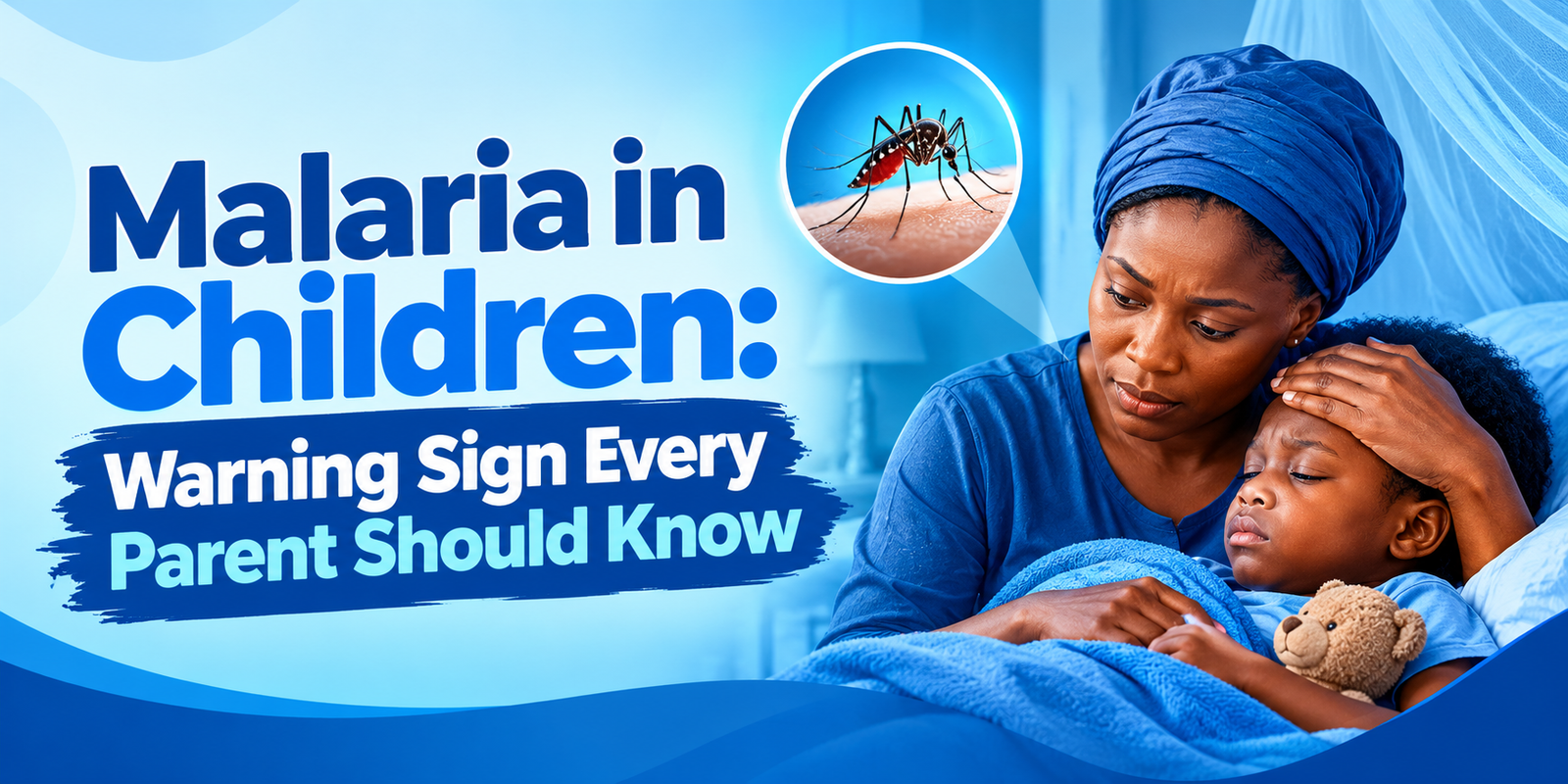
MALARIA IN CHILDREN ;GIVE 5 WARNING SIGNS EVERY PARENT SHOULD KNOW
Malaria is one of the common illnesses affecting children in Nigeria, and while many cases can be treated successfully, the disease can become severe when treatment is delayed. Children may initially appear to have an ordinary fever, but their condition can worsen quickly. As a parent or caregiver, knowing the warning signs can help you recognize when a child needs urgent medical attention. Do not wait for symptoms to become severe before seeking help. Here are five important warning signs every parent should know.
Conclusion
Malaria should never be taken lightly, especially in children. A fever may be the first sign, but symptoms such as extreme weakness, repeated vomiting, difficulty breathing, convulsions, confusion or loss of consciousness may indicate a serious condition requiring urgent care. If your child develops any of these warning signs, seek medical attention immediately. Avoid relying solely on self-medication or assuming that every fever is malaria. Early assessment, proper testing and timely treatment can make a significant difference and may save a child’s life.
High or Persistent Fever
Fever is one of the symptoms that parents commonly notice when a child has malaria. A child may suddenly become hot, develop chills, sweat heavily, or complain of feeling cold even when the body temperature is high. In some cases, the fever may come and go, while in others it may remain high for a long period. Parents may also notice that the child becomes less active, loses interest in playing, has a poor appetite, complains of headache, or simply appears different from normal. However, it is important not to assume that every fever is malaria. Children can develop fever from many other infections and illnesses, including respiratory infections and other childhood diseases. This is why a child with suspected malaria should be properly assessed and tested where appropriate rather than being given malaria medicine based only on the presence of fever. A persistent or worsening fever deserves particular attention, especially when it is accompanied by other symptoms such as weakness, vomiting, difficulty breathing, confusion, or convulsions. Parents should also pay attention to how the child behaves between episodes of fever.
A high or persistent fever should never be ignored simply because the child has had malaria before or because malaria is common in the community. Children can become seriously ill when an infection is not identified and treated appropriately. Parents should monitor the child’s temperature when possible, encourage appropriate fluids if the child is able to drink, and seek medical advice when the fever persists, becomes unusually high, or is associated with other worrying symptoms. It is particularly important to seek urgent medical care if the child becomes difficult to wake, has a seizure, develops difficulty breathing, cannot drink, repeatedly vomits, or becomes confused. Parents should avoid relying on leftover medicines or medicines prescribed for another person, because the correct treatment depends on the child’s condition and the cause of the illness. In areas where malaria is common, including many parts of Nigeria, early attention to fever is especially important. The goal is not to frighten parents every time a child develops a fever, but to encourage them to take persistent fever seriously and to recognize when a child needs professional assessment. A fever that continues or is accompanied by changes in the child’s behaviour, level of alertness or ability to drink should be treated as a reason to seek medical attention rather than simply waiting for the child to recover on their own.
Extreme Weakness or Unusual Sleepiness
A child with malaria may become noticeably weaker than usual. Parents who know their child’s normal behaviour can often recognize this change quite quickly. A normally active child may suddenly stop playing, spend most of the day lying down, lose interest in food or favourite activities, or appear too tired to walk or sit normally. The child may also become unusually sleepy and may sleep for much longer than expected. Being tired after a fever is not necessarily a sign of severe illness, because children can naturally become less active when they are unwell. The concern is when the weakness or sleepiness is unusually severe, continues to worsen, or is accompanied by other worrying symptoms. For example, a child who is difficult to wake, does not respond normally when spoken to, appears confused, cannot sit or stand as usual, or seems much less aware of what is happening around them needs urgent medical attention. Severe malaria can affect the brain and other important organs, and changes in consciousness or behaviour can be signs of a serious complication. Parents should therefore pay attention not only to whether the child is sleeping, but also to how easily the child wakes up and how the child behaves after waking.
It can sometimes be difficult for parents to decide whether a child is simply tired or dangerously weak, especially when the child has been sick for several days. One useful thing to observe is whether the child can still interact normally when awake. A child who wakes easily, recognizes family members, responds appropriately, drinks fluids and gradually becomes more active may simply be recovering from an illness. On the other hand, a child who is becoming increasingly difficult to wake, is not responding normally, cannot sit or walk when they normally can, or seems confused should not be left at home to “sleep it off.” Seek medical care immediately. Extreme weakness can also occur alongside dehydration, anaemia, low blood sugar and other serious conditions, so it is important for a healthcare professional to determine the actual cause. Parents should not wait until the child becomes unconscious before seeking help. If unusual sleepiness is accompanied by convulsions, difficulty breathing, repeated vomiting, inability to drink, severe weakness or loss of consciousness, the child should be taken to an emergency healthcare facility without delay. Early medical assessment can make an important difference because serious childhood illnesses may become more difficult to treat when care is delayed. When in doubt, it is safer to have a very weak or unusually sleepy child assessed by a qualified healthcare professional rather than assuming the child is simply tired from malaria or another common infection.
Repeated Vomiting or Inability to Drink
Vomiting can occur when a child is sick with malaria, but repeated vomiting is something parents should take seriously. A child may vomit after eating or drinking, complain of nausea, refuse food, or repeatedly bring up whatever they have taken. Occasional vomiting does not always mean that the child has severe malaria, but frequent vomiting can become dangerous because the child may lose important fluids and may not be able to replace them. Children can become dehydrated more quickly than adults, particularly when vomiting is combined with fever, sweating or diarrhoea. Parents may notice signs such as a dry mouth, fewer wet nappies or reduced urination, weakness, dizziness, unusual tiredness or a child who becomes less responsive. Another concern is when the child is unable or unwilling to drink. A sick child does not necessarily need to eat a full meal, but being able to take and retain fluids is important. If the child repeatedly vomits every drink or refuses to drink altogether, medical attention should be sought promptly.
Repeated vomiting can also make it difficult for a child to receive and keep down medicines that have been prescribed. This is one reason parents should not simply continue giving medicines at home when a child is repeatedly vomiting or becoming weaker. The child may need assessment to determine the cause of the vomiting and whether dehydration or another complication has developed. Parents should also remember that vomiting is not specific to malaria. It can occur with several infections and medical conditions, so it should not automatically be used as proof that a child has malaria. Where malaria is suspected, appropriate testing and clinical assessment are important. If a child is vomiting repeatedly, cannot drink, becomes extremely weak or sleepy, develops difficulty breathing, has convulsions, becomes confused or loses consciousness, urgent medical care is needed. Parents should not wait until the child is severely dehydrated before seeking help. While waiting for medical assessment, if the child is awake and able to drink, small amounts of appropriate fluids may be offered frequently rather than forcing the child to take a large amount at once. However, if the child cannot drink or is not fully conscious, do not force fluids or food into the child’s mouth because of the risk of choking. The most important message for parents is simple: repeated vomiting or inability to drink in a child with suspected malaria is not something to ignore. Prompt assessment can help identify the cause of the illness and prevent complications from becoming more serious.
Fast or Difficult Breathing
Fast or difficult breathing is a warning sign that parents should never ignore when a child is sick, especially when malaria is suspected. A child may start breathing much faster than normal, appear to be struggling to breathe, breathe with unusual effort, or have the chest moving rapidly with each breath. You may also notice that the child is unable to speak, cry, eat or drink normally because of difficulty breathing. For example, a child who normally plays and runs around without difficulty may suddenly become weak, lie down and breathe very rapidly even while resting. Some children may have their nostrils opening widely with each breath or the skin between the ribs pulling inward as they breathe. Fast breathing can occur with fever, but parents should not automatically assume that the breathing will return to normal when the fever goes down. It may be a sign that the child is seriously unwell and needs medical assessment. Severe malaria can cause complications that affect the child’s breathing and other vital organs, while other serious infections, including pneumonia, can also cause rapid or difficult breathing. This is why it is important not to treat the symptom at home without finding out what is causing it. If a child with suspected malaria develops difficulty breathing, becomes increasingly weak, cannot drink, or appears to be struggling for air, take the child to a healthcare facility immediately. Do not wait until the breathing becomes extremely difficult before seeking help. Early medical attention can help healthcare professionals identify the cause and provide appropriate treatment before the condition becomes more serious.
Convulsions, Confusion, or Loss of Consciousness
Convulsions, confusion, or loss of consciousness are among the most serious warning signs that a child with suspected malaria may be severely ill. A convulsion, also called a seizure, may cause the child’s body to suddenly become stiff, the arms and legs to shake uncontrollably, the eyes to roll upward, or the child to become unresponsive for a period of time. After a seizure, the child may appear extremely sleepy or confused. Confusion may also occur without a convulsion; for example, a child who normally recognizes their parents may suddenly behave strangely, stare blankly, fail to respond appropriately, or seem unaware of what is happening around them. Loss of consciousness is even more serious, particularly when the child cannot be awakened or does not respond when spoken to or gently stimulated. These symptoms require emergency medical attention because severe malaria can affect the brain, but other serious medical conditions can cause similar symptoms as well. If a child has a convulsion, parents should protect the child from injury by placing them in a safe area and, if possible, turning them onto their side. Do not put a spoon, finger, food, water or medicine into the child’s mouth during a seizure, and do not try to forcefully hold the child’s arms or legs down. Seek emergency medical care immediately, particularly if the seizure lasts several minutes, happens repeatedly, or the child does not regain normal awareness afterwards. Parents should not wait for a second or third episode before seeking help. A child who becomes confused, unconscious or has a convulsion needs urgent professional assessment and treatment.he cause of the illness and prevent complications from becoming more serious.






Post Comment